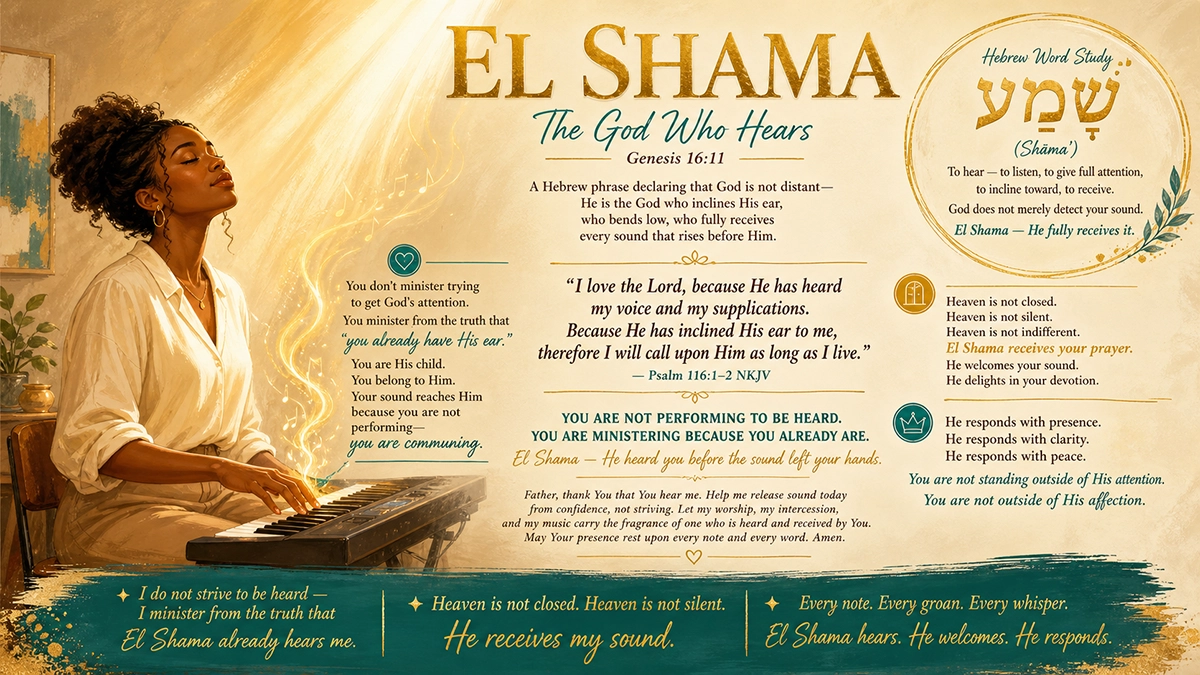
One of the greatest anchors for the minstrel is knowing that God hears. Before the sound leaves your hands, your mouth, or your heart—He has already leaned in. He is the God who bends low to listen. He receives every groan, every whisper, every intercession, every melody that rises before Him.
For the minstrel, this is not theory. This is identity. You don’t minister trying to get God’s attention—you minister from the truth that you already have His ear. You are His child. You belong to Him. Your sound reaches Him because you are not performing; you are communing.
The Testimony of the Psalms
David wrote in Psalm 6:9 (NKJV): “The Lord has heard my supplication; the Lord will receive my prayer.”
Notice the confidence in that declaration. David didn’t write “I hope the Lord hears” or “perhaps He will receive.” He wrote it as settled truth—past tense and future tense woven together. He has heard. He will receive. This was not the voice of a man whose circumstances had already changed. This was the voice of a minstrel who had learned to anchor himself in the character of God before the answer came.
David understood something that every minstrel must internalize: the act of bringing sound before God is not a petition for His attention. It is a response to the attention He has already given. When you pick up your instrument, when you open your mouth in worship, when you press into intercession through melody—you are not initiating contact. You are responding to the One who first leaned toward you.
The minstrel who plays from this place plays differently. There is no anxiety in the sound. There is no striving at the keyboard. There is no desperation in the intercession. There is only the deep, settled confidence of one who knows: I am heard.
When the Forgotten Are Found
Genesis 16:11 carries one of the most tender moments in all of Scripture. Hagar—a woman without status, without belonging, without a voice in the decisions that had shattered her world—sat alone in the wilderness. She had run from pain. She had been used and discarded. She had no altar, no tabernacle, no temple, no priest. She had nothing but her tears and the desert floor beneath her.
And God found her there.
The angel declared: “Behold, you are with child, and you shall bear a son. You shall call his name Ishmael, because the Lord has heard your affliction.” (NKJV)
Ishmael. The name means: God hears.
What is striking is not just that God heard Hagar—it is when He heard her and who she was when He heard. She was not in the congregation. She was not lifting her hands in corporate worship. She was not a recognized voice in any spiritual community. She was a fugitive, weeping beside a spring in the wilderness. And yet God heard the sound of her affliction as clearly as He would have heard a thousand trumpets in the courts of the tabernacle.
This is the character of El Shama. He does not only hear the polished sound. He does not only receive the rehearsed intercession. He hears the broken groan. He hears the silent cry. He hears what you cannot even put into words—the ache in your chest as you sit at the keys not knowing what to play, only knowing that something deep is crying out.
What This Means for the Minstrel
Hagar’s story is not a side note for the minstrel—it is a foundation. If God bent low to hear a woman no one else saw, in a place no one else would go, offering a sound no one would call worship—then nothing you bring before Him goes unnoticed. Not the imperfect chord. Not the cracked voice. Not the intercession you’re not sure is going anywhere. Not the prophetic melody that feels incomplete. Not the quiet moment at the instrument when the music hasn’t come yet and all you have is stillness.
He is El Shama. He hears all of it.
And like Hagar, when you encounter this God—when the reality that He has heard you breaks through—something changes. Hagar named the place Beer Lahai Roi: the Well of the Living One who sees me. She didn’t just receive an answer. She received a revelation of who God is. The answer was wrapped in His character.
This is what the minstrel carries into the room. Not just a song. Not just a skillful hand. But the testimony: I have been heard. I have been seen. And I play from that place.
When you sit at the keyboard, lift your hands, or release the song within you, remember: Heaven is not closed. Heaven is not silent. Heaven is not indifferent. The Lord receives your prayer. He welcomes your sound. He delights in your devotion. And He responds with presence, clarity, and peace.
Worship Activation
Before you play today, take one minute of stillness. Place your hands on your instrument or hold them open before the Lord. Say aloud: “El Shama—You hear me. I am not striving for Your attention. I already have Your ear.” Then release the first sound from that place—not performance, not intercession for an audience, but communion with the One who has already heard.
Prayer
Father, thank You that You hear me. Thank You that I never stand outside of Your attention or Your affection. Like David, I declare with confidence: You have heard my supplication, and You will receive my prayer. Like Hagar, I receive the revelation that You see me—even in the wilderness, even in the places no one else would look. Help me release sound today from confidence, not striving. Let my worship, my intercession, and my music carry the fragrance of one who is heard and received by You. I am not performing. I am communing. May Your presence rest upon every note, every word, every groan too deep for language. El Shama—I trust that You hear. Amen.
Scripture References: Psalm 6:9 | Genesis 16:11 | Romans 8:26