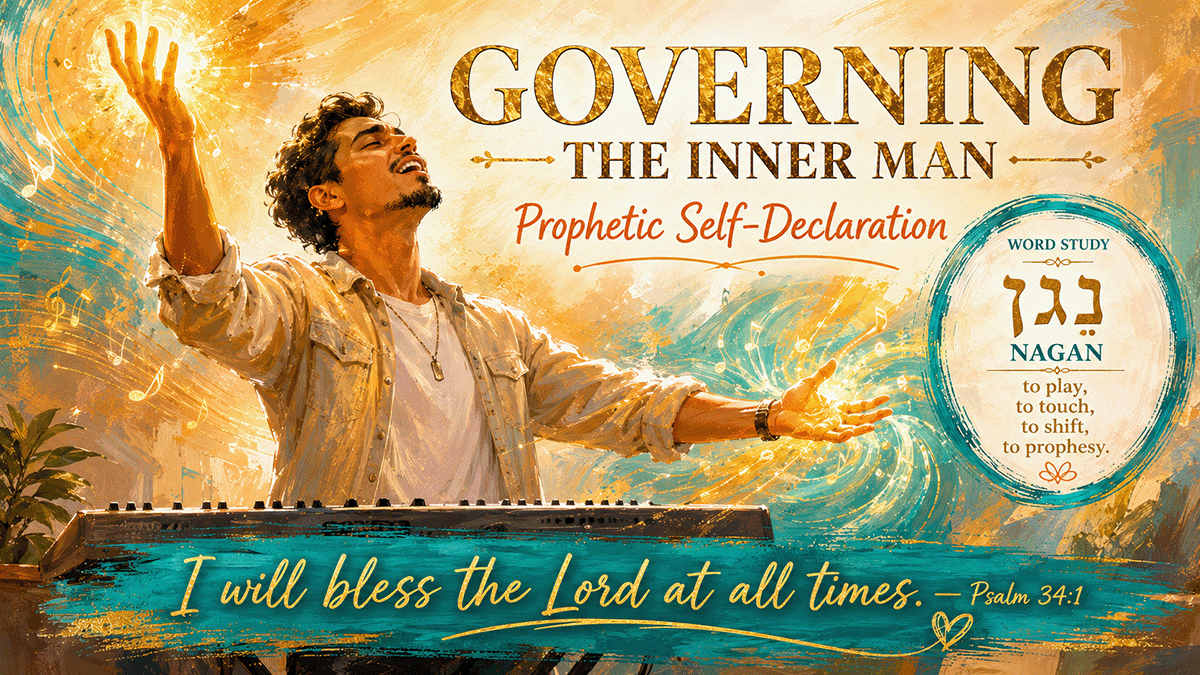
Governing the Inner Man through Prophetic Self-Declaration and Praise and Worship
Governing the inner man is one of the most critical assignments of the minstrel. There is a version of worship that is purely expressive — you sing what you feel, you play what the moment calls for, and you let the emotion carry you.
And then there is another kind.
The kind where you do not feel like worshipping. Where the soul is heavy. Where the atmosphere is resistant. Where everything on the inside is pulling in the opposite direction of praise.
That is where prophetic self-declaration comes in.
What It Is — And What It Is Not
Prophetic self-declaration is not positive thinking. It is not affirmations. It is not speaking things into existence by the power of your own will.
It is speaking revealed truth from the Word of God, under the unction of the Spirit, directly into your own soul — until your soul yields, aligns, and comes into rest.
The prophet speaks what God says. When you declare over yourself, you are functioning as your own prophet — not inventing words, but releasing what Heaven has already spoken about you. You are not creating reality. You are agreeing with the reality God already established.
You Are a Tri-Part Being
You are spirit, soul, and body. It does not automatically align with your spirit. It has to be governed. And prophetic self-declaration through praise and worship is one of the primary ways that governance happens.
“And may your whole spirit, soul, and body be preserved blameless at the coming of our Lord Jesus Christ.” — 1 Thessalonians 5:23 NKJV
Your spirit is born again. Your body follows what it is told. But your soul — the mind, will, and emotions — is the battleground.
Five Ways It Works
1. You Shift From Listener to Declarer
The soul wants to lead. The moment you open your mouth in worship and declare rather than describe — you flip the authority structure. You stop listening to your soul and start speaking to it.
David did not sing about being downcast. He asked his soul why it was downcast and told it what to do. “Hope in God.” That is a command. Not a suggestion. Not a feeling. A command.
2. The Names of God Become Weapons
When you declare “You are El Shama — the God Who Hears” over a soul that feels unheard, you are not just worshipping. You are dismantling a lie the enemy has planted. The soul bows to truth when truth is spoken with authority.
El Sali. Jehovah Uzzi. Jehovah Sali. Every name is a declaration. Every declaration is a governing act.
3. Nagan — The Sound That Shifts
The Hebrew word for the minstrel’s assignment is nagan — to play, to touch, to shift, to prophesy. Shifting is built into what you do. When you play under the anointing, you are not just creating atmosphere for others. You are first shifting your own soul into alignment.
“But now bring me a musician. Then it happened, when the musician played, that the hand of the Lord came upon him.” — 2 Kings 3:15 NKJV
The music came first. Then the prophetic moved. The same principle works inwardly. Your worship creates the inner conditions for your spirit to lead your soul.
4. Praise Breaks the Agreement With the Lie
Every time your soul is downcast, it is — knowingly or unknowingly — in agreement with something the enemy has spoken. Fear. Rejection. Unworthiness. When you lift a sacrifice of praise you break that agreement and enter a new one — agreement with the Word of God.
“Therefore by Him let us continually offer the sacrifice of praise to God, that is, the fruit of our lips, giving thanks to His name.” — Hebrews 13:15 NKJV
This is why it is called a sacrifice. It costs you something. But when you offer it anyway, the soul is brought under the authority of the spirit. That is governance.
5. Declaration Establishes Spiritual Jurisdiction
When you declare this over yourself, you are setting the terms for what has access to your inner man. Declaration in worship is not just vertical — toward God. It is horizontal — against the enemy. And it is inward — toward your own soul.
“I will bless the Lord at all times; His praise shall continually be in my mouth.” — Psalm 34:1 NKJV
A Practical Pattern
- Identify what your soul is saying. Name it. Do not ignore it. David named his downcast state.
- Ask the question. “Why, O my soul?” Interrupt the soul’s narrative. This alone begins to break its grip.
- Declare the counter-truth. Not what you feel — what God said. Speak it. Sing it. Play it. Faith comes by hearing — including hearing yourself declare truth.
“So then faith comes by hearing, and hearing by the word of God.” — Romans 10:17 NKJV
- Command your soul. “Hope in God. Bless the Lord. Return to your rest.” These are commands. The spirit man has authority over the soul. Exercise it.
- Sustain the sound until the shift comes. You nagan — you keep playing, keep touching, keep shifting — until the atmosphere inside you changes.
Your soul is not your enemy. It is a servant that has gotten out of order. Prophetic self-declaration through praise and worship is how you restore the order — so that when you step to the keys, to the altar, to the microphone, you are not ministering from a broken place. You are ministering from a governed place.
That is the minstrel who releases a sound that shifts atmospheres. Because they have first been shifted themselves.
Prophetic Declaration
Father, I thank You that I have authority over my own inner man. Right now I declare Your Word over my soul. I speak to every lie, every fear, every agreement with the enemy — it is broken, in Jesus’ name. I command my soul to hope in God, to bless the Lord, and to return to rest. I take my place as a governed vessel. Let the sound that flows from me carry the weight of Heaven. In Jesus’ name. Amen.
Stay Connected
Subscribe to the Bring Me A Minstrel community for weekly devotionals, prophetic worship teaching, and minstrel resources.
Subscribe at bringmeaminstrel.com | Follow @bringmeaminstrel on YouTube | Instagram | Facebook |TikTok